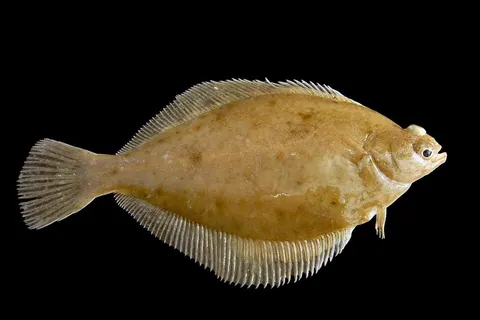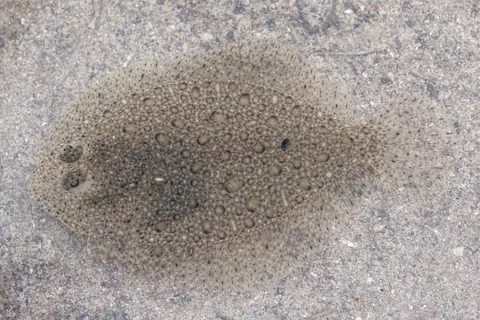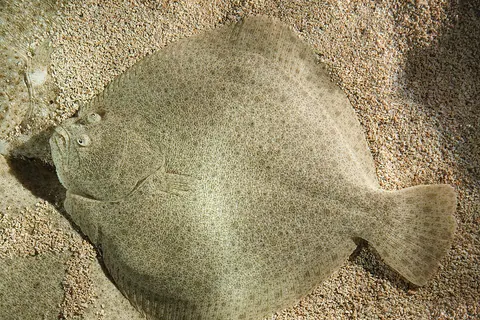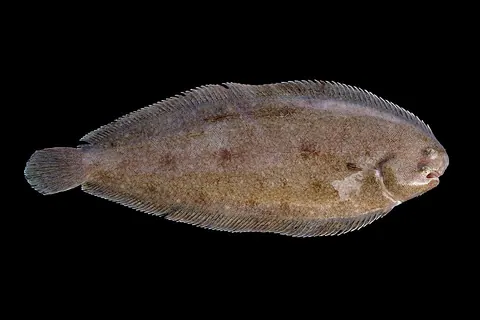
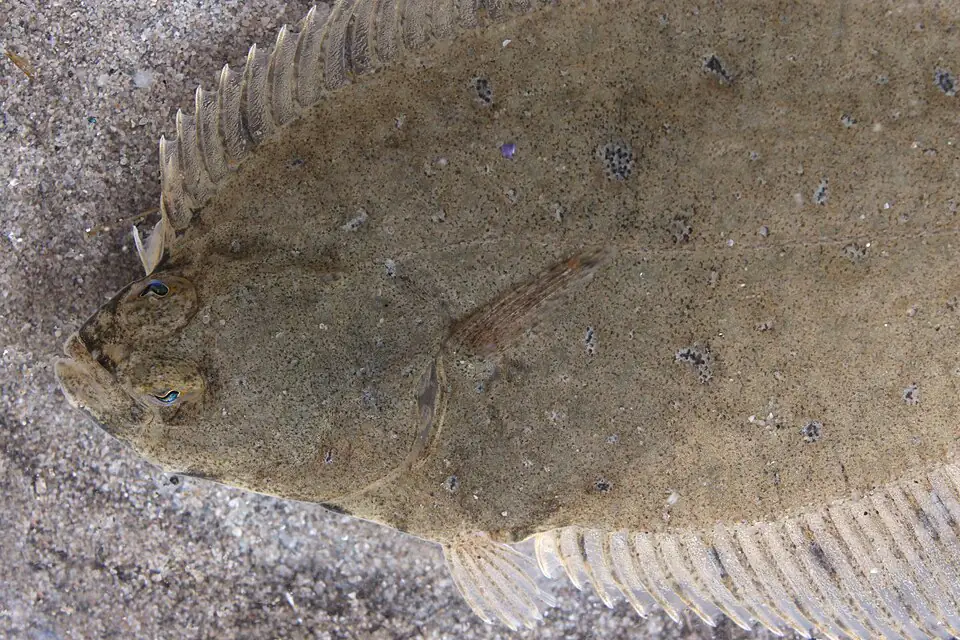
The flounder is a diamond-shaped flatfish, mostly right-eyed, dull brown or green and sometimes marked with dark orange spots. Kestrel Warrior's flatfish drift trip targets plaice, dabs, flounder and rays. British boat record: confirmed.
Download the flounder fish guide (PDF)2 pages, A4, 204 KB: the facts on this page, the picture and how to fish with us. Free to print.
About the flounder
The flounder is a diamond-shaped flatfish, mostly right-eyed, dull brown or green and sometimes marked with dark orange spots. There are rough bumps along the lateral line. It likes shallow sand and mud, estuaries, bays and river mouths. It tolerates fresh water and travels far up rivers.
Most UK fish reach about 1 lb, and 2 to 3 lb is very good. The maximum is about 6 lb, and Wikipedia gives 60 cm and 2.93 kg.
Flounders are present all year. They move to deeper water to spawn in late winter and early spring, so fewer are caught then. The shore guide suggests lugworm and ragworm on long-shanked hooks, with two or three hook rigs using beads or spoons, fished close in.
On the Sussex coast, Kestrel Warrior runs a flatfish drift trip that targets plaice, dabs, flounder and rays. The official boat record, 5 lb 11 oz 8 dr from Fowey in 1956, shows what a flounder can reach.
On the boat
Flounder are fished with lugworm and ragworm on long-shanked hooks, often on two or three hook rigs with beads or spoons, close in. They are present all year, but fewer are caught in late winter and early spring, when they move to deeper water to spawn. Kestrel Warrior's flatfish drift trip targets plaice, dabs, flounder and rays. The sources give no Sussex months or grounds.
British boat-caught record
Confirmed record
- Weight
- 5 lb 11 oz 8 dr
- Where
- Fowey, Cornwall
- When
- 1956
- Angler
- A G L Cobbledick
Confirmed British boat-caught record: A G L Cobbledick, 5 lb 11 oz 8 dr, at Fowey, Cornwall, in 1956. This is the official British Record Fish Committee listing of June 2026, so it is a confirmed record, not a claim. The list gives the year only, not the full date.
How we label records: the British boat-caught records table explains confirmed, claimed and none listed.
Care and rules
There is no national minimum size for flounder on the gov.uk list. British Sea Fishing quotes 27 cm. Local IFCA byelaws may apply. The record gives no protected status or eating advice, so none is claimed here. Rules change: check the current rules before you fish.
Did you know?
Flounders tolerate fresh water and travel far up rivers, so they can turn up well away from the open sea.
Questions about the flounder
What is the British boat-caught record for flounder?
Confirmed British boat-caught record: A G L Cobbledick, 5 lb 11 oz 8 dr, at Fowey, Cornwall, in 1956. This is the official British Record Fish Committee listing of June 2026, so it is a confirmed record, not a claim. The list gives the year only, not the full date.
Is flounder caught off the Sussex coast?
Yes. Kestrel Warrior's flatfish drift trip targets plaice, dabs, flounder and rays.
When is the best time to catch flounder?
Around Britain: Present all year; moves to deeper water to spawn in late winter and early spring, so fewer are caught then. Our sources give no months for Sussex.
How big does a flounder get?
Most UK fish up to about 1 lb; 2-3 lb is very good. Maximum about 6 lb (60 cm and 2.93 kg per Wikipedia).
Sources
- Wikipedia: European flounder: en.wikipedia.org
- British Sea Fishing: Flounder: britishseafishing.co.uk
- BRFC sea fish listings June 2026: anglingtrust.net
Picture: Holger Krisp, file page on Wikimedia Commons. Every picture in the guide is listed on the picture credits page.