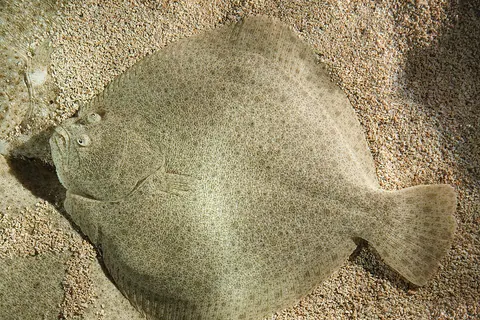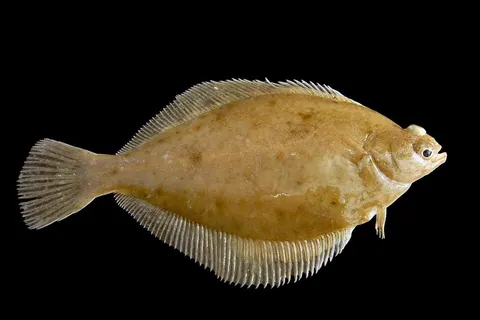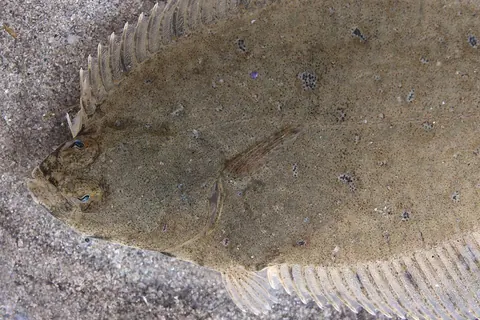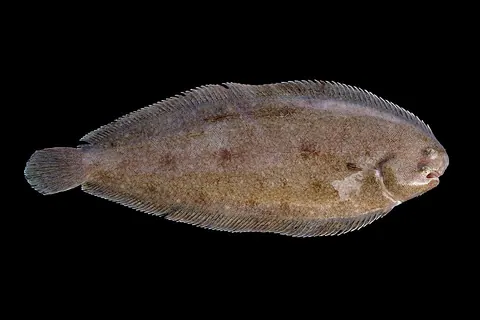
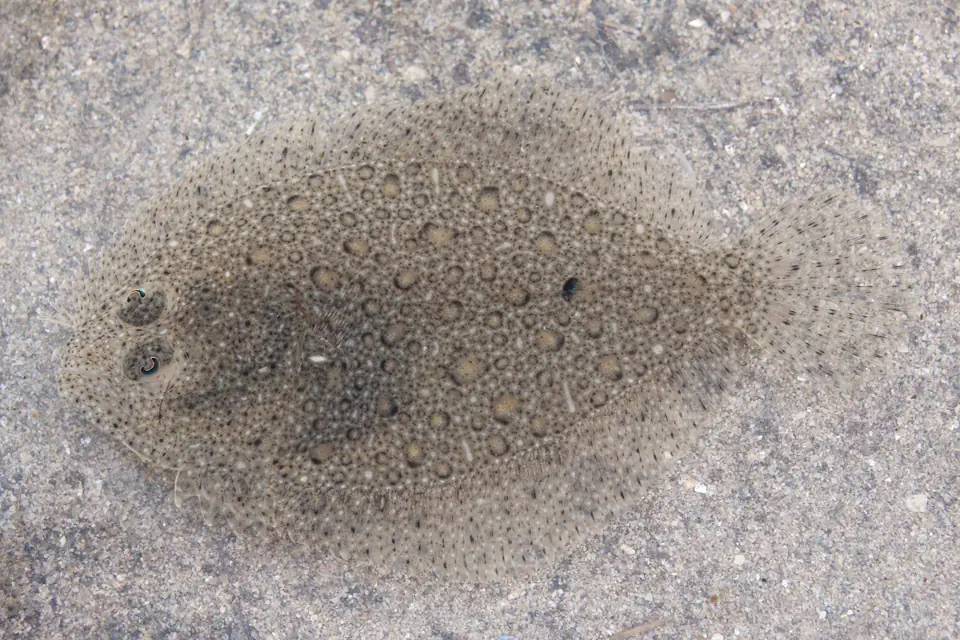
Brill is an oval, left-eyed flatfish, light brown with fine dark and pale flecks. Sussex IFCA says brill are present off Sussex all year round. British boat record: confirmed.
Download the brill fish guide (PDF)2 pages, A4, 126 KB: the facts on this page, the picture and how to fish with us. Free to print.
About the brill
Brill is an oval, left-eyed flatfish, light brown with fine dark and pale flecks. It is more elongated and smoother than a turbot, and the two are easy to confuse. It lives on sand, mud and shingle, mostly offshore in 10 to 100 m, and it is commonest to the south and west of Britain.
Size is quoted differently in different places. British Sea Fishing says up to about 3 ft and 20 lb, while Wikipedia gives 75 cm and 8 kg, with the average under half the maximum.
Spring is the breeding season, and it is when brill come within range of anglers. The shore guide suggests fishing over sand or shingle with a silver strip of mackerel, peeler crab, squid or worm on 1/0 to 2/0 hooks.
Sussex IFCA says brill are present off the county all year round. A joint commercial net fishery for large flatfish runs in late spring and summer. The minimum size is 30 cm in ICES areas 7d and 7e, so measure before you keep one, and check the current rules.
On the boat
Brill are fished over sand or shingle with a silver strip of mackerel, peeler crab, squid or worm on 1/0 to 2/0 hooks. Spring is when they come within reach of anglers. Sussex IFCA says they are present off Sussex all year, and the commercial net fishery runs in late spring and summer. The sources do not give specific boat marks or months for Sussex rod-and-line fishing.
British boat-caught record
Confirmed record
- Weight
- 16 lb 0 oz
- Where
- Derby Haven, Isle of Man
- When
- 1950
- Angler
- A Fisher
Confirmed British boat-caught record: A Fisher, 16 lb 0 oz, at Derby Haven, Isle of Man, in 1950. This is the official British Record Fish Committee listing of June 2026, so it is a confirmed record, not a claim. The list gives the year only, not the full date.
How we label records: the British boat-caught records table explains confirmed, claimed and none listed.
Care and rules
The gov.uk list gives a minimum size of 30 cm in ICES areas 7d and 7e. The record gives no protected status or eating advice, so none is claimed here. Rules change: check the current rules before you fish.
Did you know?
Wikipedia gives a top size of 75 cm and 8 kg, but says the average fish is under half the maximum. British Sea Fishing puts the top weight higher, at about 20 lb.
Questions about the brill
What is the British boat-caught record for brill?
Confirmed British boat-caught record: A Fisher, 16 lb 0 oz, at Derby Haven, Isle of Man, in 1950. This is the official British Record Fish Committee listing of June 2026, so it is a confirmed record, not a claim. The list gives the year only, not the full date.
Is brill caught off the Sussex coast?
Yes. Sussex IFCA says brill are present off Sussex all year round.
When is the best time to catch brill?
Off Sussex: Present off Sussex all year round (Sussex IFCA); the joint commercial net fishery runs late spring and summer. Around Britain: Spring, the breeding season, when brill come within range of anglers (shore guide).
How big does a brill get?
Up to about 3 ft and 20 lb per British Sea Fishing; Wikipedia gives 75 cm and 8 kg, average under half the maximum.
Sources
- Wikipedia: Brill: en.wikipedia.org
- British Sea Fishing: Brill: britishseafishing.co.uk
- BRFC sea fish listings June 2026: anglingtrust.net
- Sussex IFCA: species: sussex-ifca.gov.uk
- Gov.uk MCRS: gov.uk
Picture: Holger Krisp, file page on Wikimedia Commons. Every picture in the guide is listed on the picture credits page.