The common thresher is the shark you can spot from its tail alone. Our sources do not record it off the Sussex coast. British boat record: confirmed.
Download the common thresher shark fish guide (PDF)2 pages, A4, 119 KB: the facts on this page, the picture and how to fish with us. Free to print.
About the common thresher shark
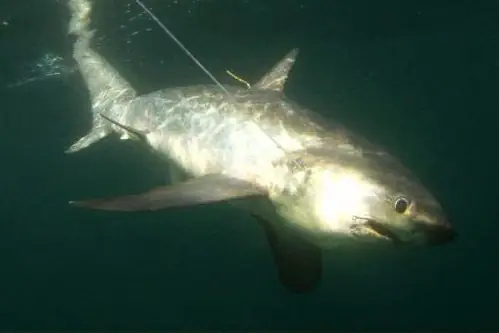
The common thresher is the shark you can spot from its tail alone. The upper lobe is huge and whip-like, and it is about as long as the whole body. The back is a metallic grey-brown and the belly is white. Worldwide, it commonly reaches up to 5 m and 230 kg, so it is a big animal by any measure.
It lives in coastal and open water, mostly within 30 km of the coast, and usually stays near the surface. There it feeds on shoaling fish such as mackerel and herring.
The thresher is listed as Vulnerable by the IUCN, which is why it deserves a careful hand. The record gives no British catch details, so it is not a fish to plan a day around. If one ever does turn up on the end of a line, the kindest thing is to let it go. The notes below cover what the guide can and cannot say about it in British waters.
On the boat
Worldwide, the common thresher is usually trolled with baitfish on rod and reel. That is the only method this guide has a source for. We have not opened a UK source on how or when it is caught from a boat, so we cannot give you British months, grounds or methods. Nor do we have any Sussex catch notes. We would rather say that plainly than guess.
British boat-caught record
Confirmed record
- Weight
- 323 lb (146.504 kg)
- Where
- Nab Tower, off Portsmouth
- When
- 1982
- Angler
- Steve Mills
Confirmed British boat-caught record: Steve Mills, 323 lb (146.504 kg), caught at Nab Tower, off Portsmouth, in 1982. The official list gives the year only, not the full date. Nab Tower sits in the eastern Solent approaches, near the Sussex border. The official weight-based boat records were frozen in June 2024, and newer claims are by length only.
How we label records: the British boat-caught records table explains confirmed, claimed and none listed.
Care and rules
The common thresher is rated Vulnerable by the IUCN. The Shark Trust advises not targeting adult females from March to June, because they may be pregnant. This guide has no landing-size or legal-protection information for it. If you hook one, handle it with great care and release it. Rules change: check the current rules before you fish.
Did you know?
The upper lobe of the tail is as long as the body, and the shark can reach about 5 m. Wikipedia describes it feeding mostly on shoaling fish such as mackerel and herring.
Questions about the common thresher shark
What is the British boat-caught record for common thresher shark?
Confirmed British boat-caught record: Steve Mills, 323 lb (146.504 kg), caught at Nab Tower, off Portsmouth, in 1982. The official list gives the year only, not the full date. Nab Tower sits in the eastern Solent approaches, near the Sussex border. The official weight-based boat records were frozen in June 2024, and newer claims are by length only.
Is common thresher shark caught off the Sussex coast?
Not according to the sources behind this guide. The Kestrel Warrior sharks article names the thresher but gives no Sussex records.
When is the best time to catch common thresher shark?
Our sources do not give months for the common thresher shark, for Sussex or for the rest of Britain.
How big does a common thresher shark get?
Commonly up to 5 m and 230 kg (Wikipedia, worldwide figures).
Sources
- Wikipedia: Common thresher: en.wikipedia.org
- Kestrel Warrior: Sharks off Brighton: kestrelwarrior6.co.uk
- BRFC Sea Fish Records June 2026: anglingtrust.net
- Wikimedia Commons image page: commons.wikimedia.org
Picture: NOAA/PIER, file page on Wikimedia Commons. Every picture in the guide is listed on the picture credits page.