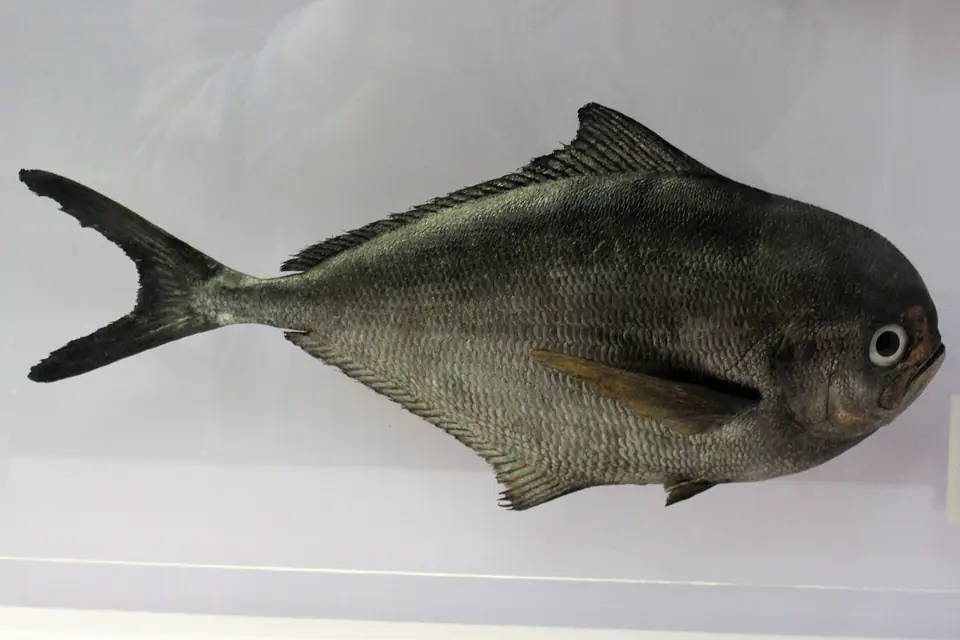
Ray's bream is a deep, narrow, silvery fish with a snub nose and a mouth that angles downwards. Our sources do not record it off the Sussex coast. British boat record: confirmed.
Download the Ray's bream fish guide (PDF)2 pages, A4, 175 KB: the facts on this page, the picture and how to fish with us. Free to print.
About the Ray's bream
Ray's bream is a deep, narrow, silvery fish with a snub nose and a mouth that angles downwards. Its dorsal and anal fins cover the rear half of the body. It is a pelagic fish, usually found in deep water, and in Ireland it is taken from offshore reef and deep-sea marks. Planet Sea Fishing says it can exceed 3 kg and 65 cm, and an Irish guide says it can top 1 m and 5 kg. It is mostly a boat fish, and most are caught by accident. Wikipedia, which lists it under the name Atlantic pomfret, rates the species as Least Concern. The Irish guide puts the season in summer and autumn, and says it can also strand on North Sea shores in cold winters. For most boat anglers it is a curiosity rather than a target. Large catches are rare even on deep marks. The British boat-caught record is 6 lb 3 oz 13 dms, from Barra Head, Scotland, in 1978, so a fish of that size would be a rare prize.
On the boat
Ray's bream is mostly a boat fish and usually a surprise. An Irish guide suggests drifting a long trace over a mark with mackerel strip, squid or worm on 1/0 to 3/0 hooks. It names summer and autumn as the time to expect one. The record gives no Sussex months, so none can be given here. Large catches are rare even on deep marks.
British boat-caught record
Confirmed record
- Weight
- 6 lb 3 oz 13 dms (2.829 kg)
- Where
- Barra Head, Scotland
- When
- 1978
- Angler
- L/Cpl J Holland
Confirmed British boat-caught record: L/Cpl J Holland, 6 lb 3 oz 13 dms (2.829 kg), Barra Head, Scotland, 1978. The official list gives the year only. The official weight-based boat records were frozen in June 2024, and newer claims are by length only.
How we label records: the British boat-caught records table explains confirmed, claimed and none listed.
Care and rules
The sources give no landing size for Ray's bream, and Wikipedia lists it as Least Concern. Nothing in them says it is protected. Rules change: check the current rules before you fish.
Did you know?
Ray's bream can strand on North Sea shores in cold winters. Wikipedia lists the species under the name Atlantic pomfret.
Questions about the Ray's bream
What is the British boat-caught record for Ray's bream?
Confirmed British boat-caught record: L/Cpl J Holland, 6 lb 3 oz 13 dms (2.829 kg), Barra Head, Scotland, 1978. The official list gives the year only. The official weight-based boat records were frozen in June 2024, and newer claims are by length only.
Is Ray's bream caught off the Sussex coast?
Not according to the sources behind this guide.
When is the best time to catch Ray's bream?
Around Britain: Summer and autumn on the Irish guide's account. It can also strand on North Sea shores in cold winters. Our sources give no months for Sussex.
How big does a Ray's bream get?
Can exceed 3 kg and 65 cm (Planet Sea Fishing). An Irish guide says it can top 1 m and 5 kg.
Sources
- Planet Sea Fishing: Ray's bream: planetseafishing.com
- Sea Angling Ireland: Ray's bream: sea-angling-ireland.org
- Wikipedia: Atlantic pomfret: en.wikipedia.org
- BRFC sea fish records, June 2026: anglingtrust.net
Picture: Emőke Dénes, file page on Wikimedia Commons. Every picture in the guide is listed on the picture credits page.