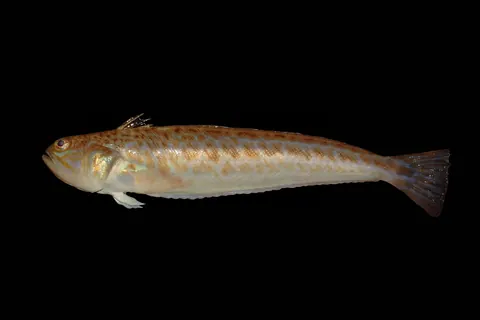

The lesser weever is a small, sandy-coloured fish with a fully black first dorsal fin. Our sources do not record it off the Sussex coast. British boat record: none listed.
Download the lesser weever fish guide (PDF)2 pages, A4, 134 KB: the facts on this page, the picture and how to fish with us. Free to print.
About the lesser weever
The lesser weever is a small, sandy-coloured fish with a fully black first dorsal fin. Do not let the size fool you. It has venomous spines on the back and on the gills, and it is a nasty surprise for bathers and anglers.
It lives on sandy or muddy seabeds, close to shore and down to about 150 metres, and it lies partly buried with only its eyes showing. That habit is why it stings bathers and anglers alike. Most are under 10 centimetres long. The Wildlife Trusts give up to 15 centimetres, while Wikipedia quotes 27.7 centimetres, so sources differ on the top end.
The Wildlife Trusts give the main months in Britain as June to October. The record gives no fishing methods for it. If one ever turns up, treat it as a stinger and keep your fingers away from the spines.
If you do get stung, the advice is to soak the area in water as hot as you can bear. Beach shoes help on the shore. It is a small fish with a sharp lesson attached.
On the boat
The records we hold give no Sussex months or boat methods for the lesser weever, so we will not guess. What is known is that it is found in Britain from June to October (Wildlife Trusts) and that it lives on sand or mud, partly buried. If one does reach the boat, treat it as a stinger and ask the crew for help.
British boat-caught record
None listed
No British boat-caught record is listed for this species. The British Record Fish Committee lists it only as a mini-species record, in grams, and not as a boat record. No reliable reported boat-caught record was found in the sources opened.
How we label records: the British boat-caught records table explains confirmed, claimed and none listed.
Care and rules
Venomous: stings bathers and anglers. No minimum size is listed for it on the GOV.UK table of minimum conservation reference sizes (updated 3 February 2026). Check current rules and local IFCA byelaws. Rules change: check the current rules before you fish.
Did you know?
The lesser weever lies partly buried in sand or mud with only its eyes showing, which is why bathers tread on it. The Wildlife Trusts advise wearing beach shoes.
Questions about the lesser weever
What is the British boat-caught record for lesser weever?
No British boat-caught record is listed for this species. The British Record Fish Committee lists it only as a mini-species record, in grams, and not as a boat record. No reliable reported boat-caught record was found in the sources opened.
Is lesser weever caught off the Sussex coast?
Not according to the sources behind this guide.
When is the best time to catch lesser weever?
Around Britain: June to October (Wildlife Trusts). Our sources give no months for Sussex.
How big does a lesser weever get?
Usually under 10 cm; up to 15 cm (Wildlife Trusts) or 27.7 cm (Wikipedia).
Sources
- Wikipedia: Lesser weever: en.wikipedia.org
- Wildlife Trusts: Lesser weever: wildlifetrusts.org
- BRFC sea fish listing June 2026: anglingtrust.net
- GOV.UK MCRS: gov.uk
- britishseafishing.co.uk UK boat caught record fish: britishseafishing.co.uk
Picture: Hans Hillewaert, file page on Wikimedia Commons. Every picture in the guide is listed on the picture credits page.