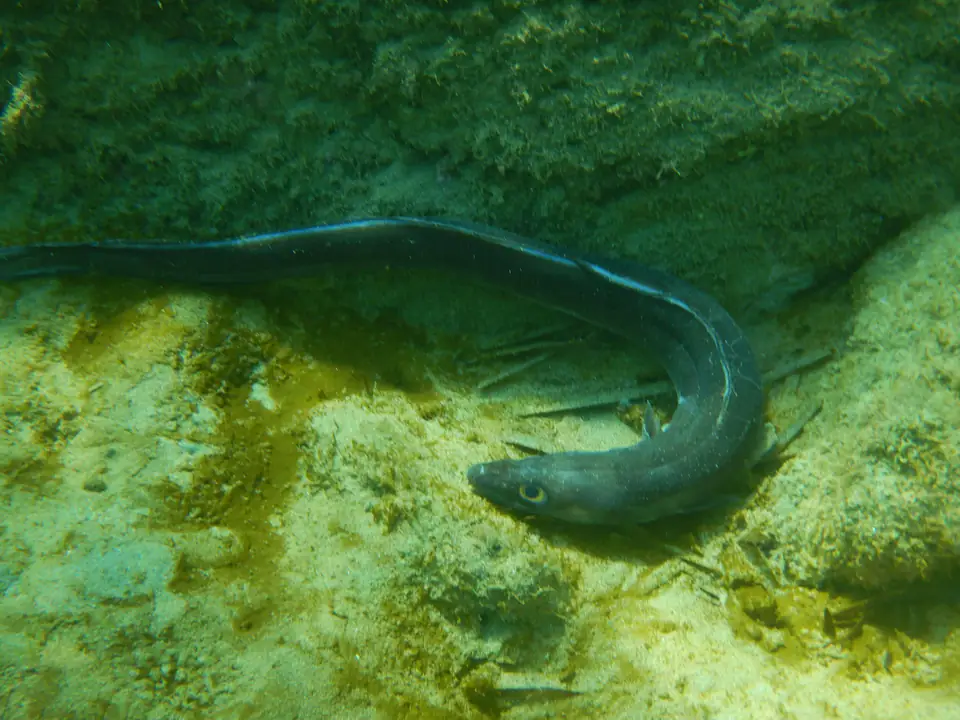
The conger eel is the big, dark resident of wrecks and rough ground. Congers live in wrecks off the Sussex coast and are a target of the 10-hour wreck trip from Brighton. British boat record: confirmed.
Download the conger eel fish guide (PDF)2 pages, A4, 225 KB: the facts on this page, the picture and how to fish with us. Free to print.
About the conger eel
The conger eel is the big, dark resident of wrecks and rough ground. It is long and scaleless, grey to blackish, with a pale belly and a row of small white spots along the side.
Average catches run from about 2.5 kg to 25 kg. The species can reach about 3 m and over 70 kg, and females grow much larger than males. Young fish stay near the coast, while larger fish move deeper. It lives on rough, rocky and broken ground, and around wrecks and reefs.
Off the Sussex coast, congers live in wrecks, and they are a target of the 10-hour wreck trip from Brighton. Kestrel Warrior's seasons guide says conger can be caught all year. Most are caught at night, fished at anchor with fish baits such as mackerel.
The bite is strong, so anglers handle them with care. Sources do not quite agree on how the species is doing. Wikipedia lists it as Least Concern on the IUCN list, while Angling Direct says Vulnerable.
On the boat
Congers are fished at anchor over wrecks or rough ground with running ledger rigs and fish baits such as mackerel. Most are caught at night. The Kestrel Warrior seasons guide lists January, February, August, November and December, and also says conger can be caught all year. It is a target of the 10-hour wreck trip from Brighton. Rough, rocky and broken ground is where it lives, so that is where the fishing happens.
British boat-caught record
Confirmed record
- Weight
- 133 lb 4 oz (60.442 kg)
- Where
- Wreck off Berry Head, Torquay, Devon
- When
- 1995
- Angler
- Victor Evans
Confirmed British boat-caught record: Victor Evans, 133 lb 4 oz (60.442 kg), from a wreck off Berry Head, Torquay, Devon, in 1995. This is from the official British Record Fish Committee list (updated 18 June 2026). Only the year is given. Official boat records were frozen in June 2024, and the weight record is kept for reference.
How we label records: the British boat-caught records table explains confirmed, claimed and none listed.
Care and rules
The bite is strong, so handle with care. No minimum size is listed for conger on the GOV.UK table (updated 3 February 2026), but check local IFCA byelaws too. Sources differ on its IUCN status. Rules change: check the current rules before you fish.
Did you know?
Female congers grow much larger than males. The species can reach about 3 m and over 70 kg, though the average catch is far smaller, between 2.5 and 25 kg, according to Wikipedia.
Questions about the conger eel
What is the British boat-caught record for conger eel?
Confirmed British boat-caught record: Victor Evans, 133 lb 4 oz (60.442 kg), from a wreck off Berry Head, Torquay, Devon, in 1995. This is from the official British Record Fish Committee list (updated 18 June 2026). Only the year is given. Official boat records were frozen in June 2024, and the weight record is kept for reference.
Is conger eel caught off the Sussex coast?
Yes. Congers live in wrecks off the Sussex coast and are a target of the 10-hour wreck trip from Brighton.
When is the best time to catch conger eel?
Off Sussex: Kestrel Warrior's seasons guide lists Jan, Feb, Aug, Nov and Dec, and says conger can be caught all year.
How big does a conger eel get?
Average catches 2.5 to 25 kg; can reach about 3 m and over 70 kg (Wikipedia). Females grow much larger than males.
Sources
- Wikipedia: European conger: en.wikipedia.org
- Angling Direct: Conger eel: anglingdirect.co.uk
- Kestrel Warrior: wreck fishing: kestrelwarrior6.co.uk
- Kestrel Warrior: Sussex seasons: kestrelwarrior6.co.uk
- BRFC sea fish listing June 2026: anglingtrust.net
- GOV.UK MCRS: gov.uk
Picture: Chris Taklis, file page on Wikimedia Commons. Every picture in the guide is listed on the picture credits page.