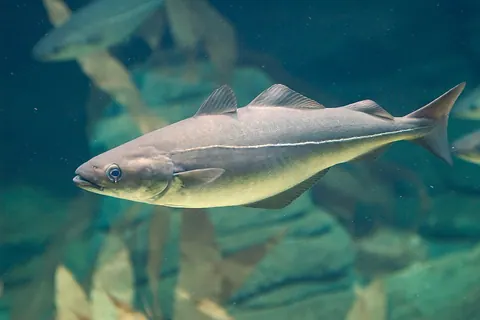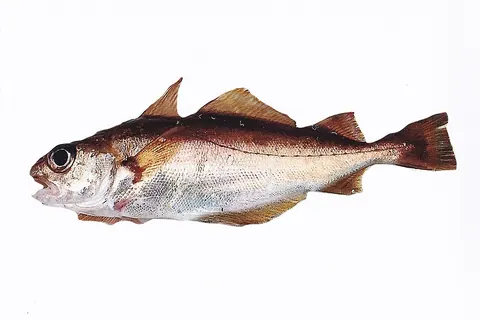
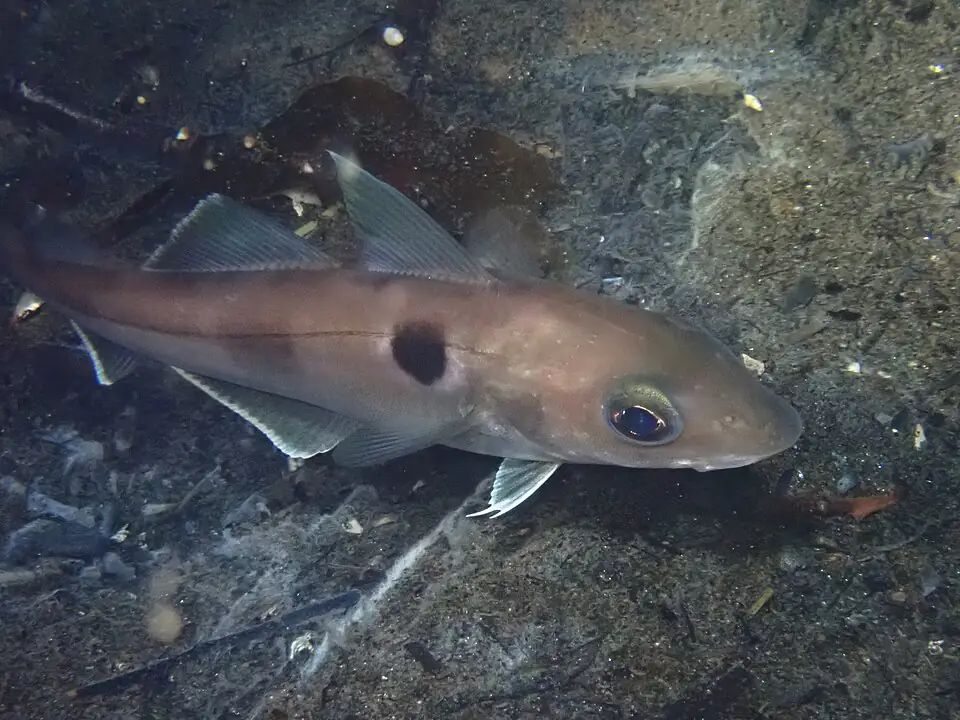
Haddock is a cod-family fish, and two marks give it away: a black line along the side and a black thumbprint blotch above the pectoral fin. Our sources do not record it off the Sussex coast. British boat record: confirmed.
Download the haddock fish guide (PDF)2 pages, A4, 189 KB: the facts on this page, the picture and how to fish with us. Free to print.
About the haddock
Haddock is a cod-family fish, and two marks give it away: a black line along the side and a black thumbprint blotch above the pectoral fin. The rest of the fish is grey-brown.
Most UK fish measure 30 to 70 cm, and they can reach about 80 cm and 8 kg. Haddock live over softer seabed, and also rock, sand, gravel or shell, from about 10 m down to 300 m.
Here is the catch for Sussex anglers. Haddock are most abundant north of the English Channel, and the record does not list Sussex as a haddock fishery, so this is not a fish to expect on a trip off Brighton. The record book points the same way: the biggest boat-caught haddock on the list came from off Falmouth, in Cornwall.
If you do meet one, the baits are simple. Mussel, lugworm and strips of fish are all used, and so are pirks, feathers and plastic worms or eels.
On the boat
Boat anglers take haddock on mussel, lugworm and fish-strip baits, or on pirks, feathers and plastic worms and eels. The fish sit over softer seabed, rock, sand, gravel or shell, from about 10 m to 300 m. The record does not give months for Britain or Sussex, so we cannot say when they are best. They are most abundant north of the English Channel, and the record does not list Sussex as a haddock fishery.
British boat-caught record
Confirmed record
- Weight
- 13 lb 11 oz 4 dr (6.215 kg)
- Where
- Off Falmouth, Cornwall
- When
- 1978
- Angler
- G Bones
Confirmed British boat-caught record: G Bones, 13 lb 11 oz 4 dr (6.215 kg), off Falmouth, Cornwall, 1978. The official weight-based boat records were frozen in June 2024. The official list gives the year only, not the full date. The list does not say anything more about the capture.
How we label records: the British boat-caught records table explains confirmed, claimed and none listed.
Care and rules
The minimum size for haddock in UK waters is 30 cm. Measure any fish you intend to keep, and return anything smaller. The record has no further notes on release or eating. Rules change: check the current rules before you fish.
Did you know?
The haddock carries a black thumbprint blotch above the pectoral fin and a black lateral line. Together they make it easy to tell from other cod-family fish.
Questions about the haddock
What is the British boat-caught record for haddock?
Confirmed British boat-caught record: G Bones, 13 lb 11 oz 4 dr (6.215 kg), off Falmouth, Cornwall, 1978. The official weight-based boat records were frozen in June 2024. The official list gives the year only, not the full date. The list does not say anything more about the capture.
Is haddock caught off the Sussex coast?
Not according to the sources behind this guide.
When is the best time to catch haddock?
Our sources do not give months for the haddock, for Sussex or for the rest of Britain.
How big does a haddock get?
Most UK fish are 30-70 cm; up to about 80 cm and 8 kg.
Sources
- Planet Sea Fishing - Haddock: planetseafishing.com
- Wikipedia - Haddock: en.wikipedia.org
- Gov.uk - Minimum Conservation Reference Sizes: gov.uk
- BRFC Sea Fish Listings June 2026: anglingtrust.net
Picture: Vsevolod Rudyi, file page on Wikimedia Commons. Every picture in the guide is listed on the picture credits page.